

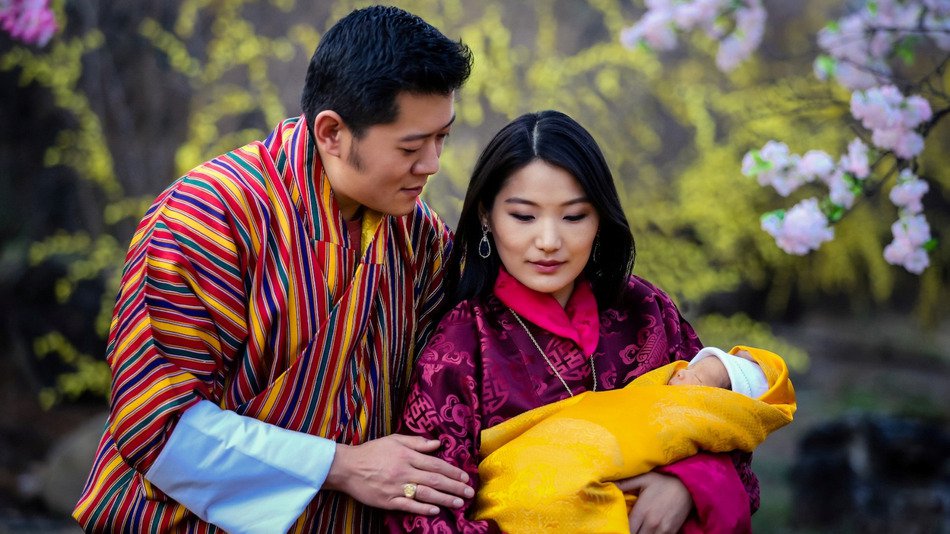
A prince was born in the beautiful Himalayan Kingdom of Bhutan and the country celebrated in a unique and truly wonderful way – by planting over one lakh trees. When a son was born to King Khesar and Queen Jetson, each household in Bhutan planted a tree to mark the event – an event important for symbolical and ecological reasons.
108,000 trees were planted
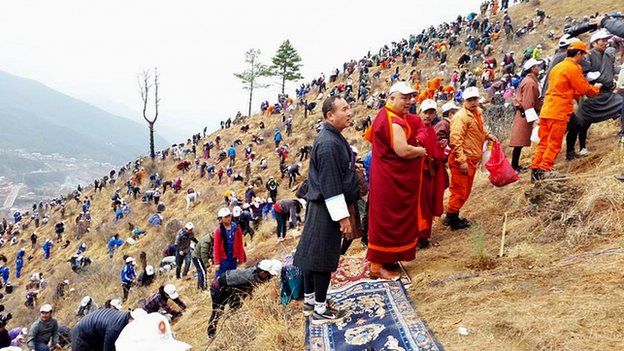
Over one lakh trees were planted: Each of the 82,000 households in Bhutan planted a tree and volunteers planted the other 26,000 trees in various districts all over the nation. In Buddhism, the main religion in Bhutan, trees have a special significance for several reasons; among them being the fact that Gautam Buddha attained enlightenment under a banyan tree. Trees are considered to be the “provider and nourisher of all life forms, symbolizing longevity, health, beauty and even compassion”. Also the trees symbolise the good wishes of the people who wish that their crown price should grow up healthy, strong, compassionate and wise; much like a tree.
And why 108,000 trees? The number 108 has special significance in Buddhism as it denotes the number of defilements that obstruct the path to human enlightenment. The inauguration of the Happiness Garden in capital city Thimpu also coincided with the event. Tourists visiting the area are encouraged to plant a tree here; with the aim that all the countries of the world will one day be represented here.
The concept of Gross National Happiness Index
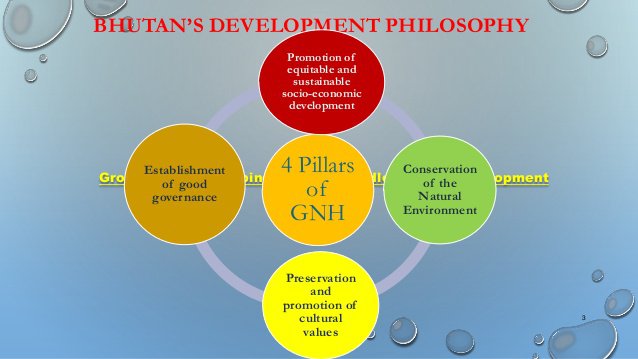
This is a global generic development measurement framework that examines various parameters such as economic, environmental, physical, mental, work, social, and political wellness of the people of a country. Bhutan has its own version of the Gross National Happiness index, a concept introduced by the Fourth King of Bhutan, Jigme Singye Wangchuck in the 1970’s which also concentrates on non-economic aspects of people’s well-being.
Bhutan is strongly committed to environmental preservation; as evidenced by the country’s pledge to remain carbon neutral (the country’s forests take in more carbon dioxide than the country as a whole produces). By 2020, the country aims to eliminate all greenhouse gas emissions and aims at turning organic. Bhutan is also looking to achieve zero-waste by 2030.
The fact that great weightage is given to aspects such as good governance, sustainable socio-economic development, cultural preservation, and environmental conservation is among the reasons why the monarchy is so popular in Bhutan; why the people of the country know the importance of planting trees and why they were happy to do so at the birth of their crown prince.
Author – Reena Daruwalla